Temporomandibular joint (TMJ) disorders–sometimes abbreviated as TMD–can cause persistent headaches, jaw pain, facial tension, and other symptoms that interfere with daily life. Because these symptoms often overlap with other conditions, many people struggle for years without finding the true cause of their discomfort. Identifying problems with the jaw joint and bite requires a detailed, specialized approach to diagnosis and care.
Dr. Michael Chung has advanced training in diagnosing and treating TMJ disorders using physiologic and neuromuscular dentistry techniques. By evaluating how the teeth, jaw joints, and muscles work together, he and his team at Softouch Dental Care can develop a treatment plan focused on relieving pain and restoring comfortable jaw function.
Call our office today at 703-319-6990 to arrange your free consultation. We welcome patients from Oakton, Vienna, McLean, and surrounding Northern Virginia communities.
What is TMJ?
A majority of Americans suffer to some extent from the symptoms of temporomandibular joint disorder, which involves a misaligned jaw joint.
Your jaw joints are in front of your ears, and you can feel them by placing a finger there and opening your mouth. They are ball-and-socket joints with a cartilage pad that cushions the bones and prevents them from rubbing against each other.
When the lower jaw (mandible) closes, the upper and lower teeth should meet smoothly and comfortably. This is your occlusion, also known more informally as your bite. A misaligned jaw can cause malocclusion: teeth meeting in an incorrect and unhealthy way (also called a bad bite). Many painful TMJ symptoms can result from a bad bite.
TMD Causes
The causes of TMD are not all fully understood. The jaw joint can be knocked out of position by a blow to the head, as you might sustain in a sports or road accident. It can also be gradually pushed out of position–for example, by a tooth-grinding habit or by misaligned or crowded teeth that constantly meet in a bad bite.
Bruxism–the medical term for grinding your teeth and clenching your jaw–exerts two to three times the normal amount of pressure on your TMJ. That constant pressure stresses the bones and muscles of your mouth as well as your jaw joint, not to mention the damage it does to your teeth. Bruxism can be a symptom of TMJ and a potential cause.
Additionally, a severe overbite or underbite, or a tooth that sits funny, may affect chewing, stressing the jawbone and the muscles of your mouth. These stresses can radiate and cause symptoms that do not seem associated with jaw pain, but they often are.
Other causes of TMD include:
- Genetic disposition
- Trauma
- Diet
- Disease
- Stress
TMJ Headaches
Headaches are one of the most common symptoms associated with temporomandibular joint disorder. For many people, these headaches occur frequently and can become severe enough to interfere with daily activities. Because headache symptoms can have many possible causes, TMJ disorders are not always considered right away, leaving the underlying issue untreated.

TMJ-related headaches are often similar to tension headaches, which many patients describe as a tight band or pressure around the head. This can happen when the jaw joint is not functioning properly, causing the surrounding muscles in the face, jaw, neck, and shoulders to remain in a constant state of tension. Overworked muscles can lead to discomfort that radiates throughout the head and upper body.
These headaches are sometimes mistaken for migraines, and medication may only provide temporary relief. Identifying the source of the problem is important. With a thorough evaluation, Dr. Chung can determine whether TMJ dysfunction is contributing to your headaches and recommend treatment designed to relieve jaw strain and reduce recurring pain.
Other Common TMJ or TMD Symptoms
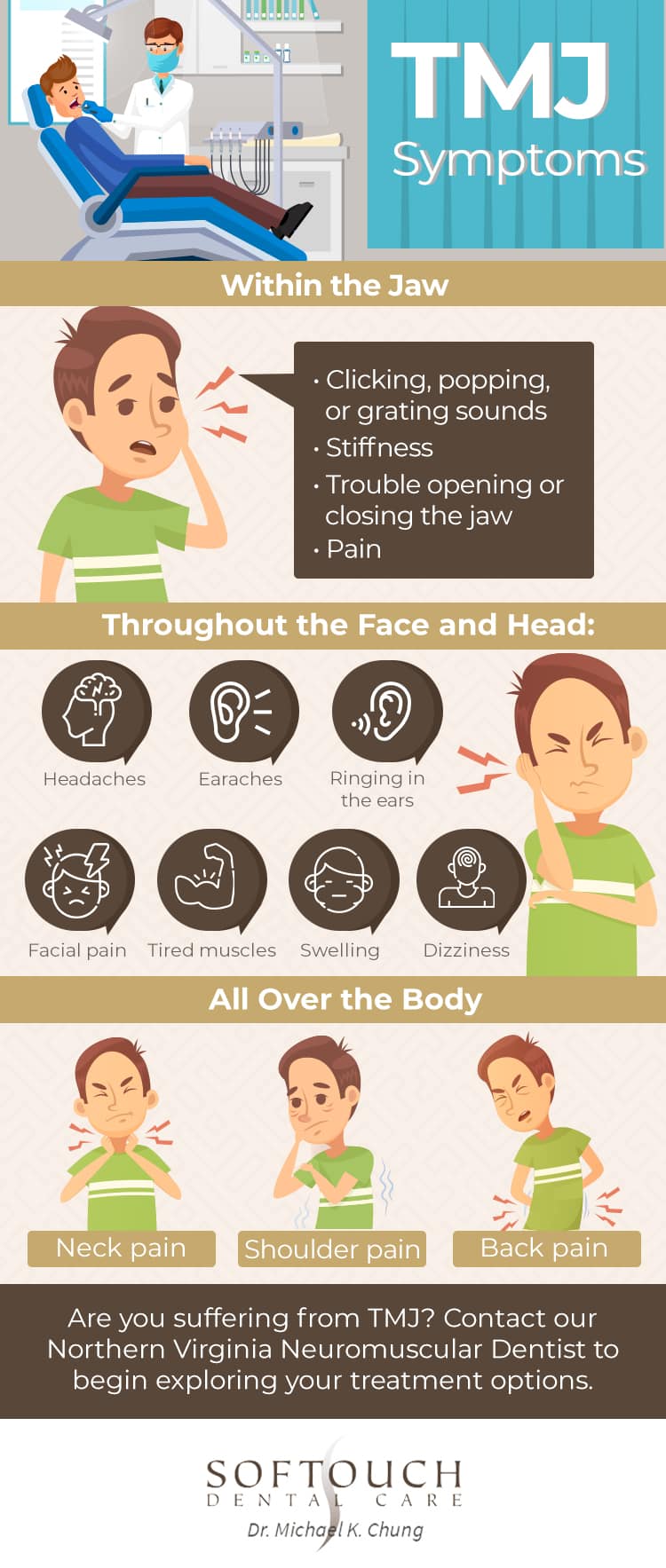
In addition to headaches, you can experience various TMJ symptoms across your body, such as:
- Jaw clicking: Another common TMD symptom is jaw clicking. Generally, the clicks are felt and heard only by the person with TMD, but they may be loud enough for others to hear. Over time, the clicks may worsen, leading to additional symptoms.
- Jaw locking: Frequently associated with jaw clicking, jaw locking can occur when the TMJ becomes so misaligned that the hinge catches. Usually, you have to move your jaw laterally to unlock it.
- Stiff jaw and facial pain: Overworked muscles ache and stiffen. With TMD, your muscles are often overworked, even while you are sleeping. If you grind your teeth at night, you may wake up with sore, stiff jaw muscles around the TMJ.
- Sensitive teeth: This symptom is frequently associated with other causes of TMD, like bruxism. If your teeth are inexplicably and generally sensitive, it may be due to TMD.
- Earaches and ringing in the ears: Because of the proximity of the TMJ to the structures of the ear, pain may radiate there. Other ear symptoms, such as tinnitus (ringing of the ears), may be associated with TMD.
- Neck and shoulder pain: The pain from your misaligned jaw joints can radiate to your neck and shoulders as well. If you have shoulder pain, you probably wouldn't think that a jaw issue could be causing your discomfort. The truth is, TMJ can cause symptoms in some unexpected places.
Dr. Chung has extensive experience in diagnosing and treating TMD in Northern Virginia.
TMD Diagnosis
Many people who come to us with TMD symptoms have had those symptoms for a long time. In many cases, physiologic/neuromuscular dentistry provides a solution for the pain associated with temporomandibular joint dysfunction.
As a highly qualified physiologic/neuromuscular dentist, Dr. Chung has invested in sophisticated equipment to diagnose and treat TMJ disorders. This equipment includes the 3D Cone Beam Dental Scanner and the K7 Evaluation System.
The K7 System helps us obtain the following data, essential for diagnosing TMD:
- Data on your jaw movements: A misaligned jaw joint can cause the mandible (lower jaw) to move uncomfortably or painfully, preventing the upper and lower teeth from coming together smoothly. The K7 system tracks and records your jaw movements.
- Data on your jaw muscle activity: If you have TMD, your jaw muscles are in constant stress, and their electrical activity can be measured and recorded using electrodes.
- Data on your jaw joint sounds: One of the TMD symptoms is cracking or popping sounds from the jaw joint. The K7 System will record the sounds as your lower jaw moves, so we can better understand how the ball on the lower jaw moves within the upper jaw socket. There is a cartilage pad in between the two bone surfaces, which prevents them from rubbing directly against each other. It could be out of position.
Another diagnostic tool Dr. Chung uses is our tomography machine, which makes digital images of the jaw joint and its related structures. This gives us more data on how the lower and upper jaw bones are positioned relative to each other.
TMJ Treatments
Every case of TMD is unique, and your treatment plan will be yours alone. Possible solutions include:
- Dental work: A misaligned jaw usually accompanies misaligned teeth. Dr. Chung will work on your bite, potentially reshape or reposition some teeth, replace any missing teeth, and possibly recommend porcelain tooth crowns. The goal is to have your upper and lower teeth meet correctly, without bumping or wearing on each other.

- An orthotic: Your jaw muscles may need some retraining to correct their habitual movements. If that is the case, Dr. Chung will devise a customized appliance for you to wear temporarily.
- Physical therapy: Sometimes physical therapy is helpful to relax the whole jaw area–face, neck, and shoulders–and to help you relearn how to use the muscles related to the jaw.
- TENS (Transcutaneous Electrical Nerve Stimulation) therapy: This device features small electrodes that gently stimulate your jaw muscles until they relax.
- BOTOX® injections: BOTOX relaxes overactive jaw muscles, reducing pain, clenching, and TMJ-related tension.
- Pain medication: Medication help sto manage acute symptoms, as it can take time to feel significant relief.
Why Choose Softouch Dental Care for TMJ Treatment in Vienna, VA?
Softouch Dental Care offers TMJ treatment backed by extensive education and advanced training. Dr. Michael Chung earned his dental degree from the University of Maryland after graduating from Johns Hopkins University and has completed more than fifteen years of post-doctoral study at the Las Vegas Institute for Advanced Dental Studies (LVI), where he is recognized as an LVI Fellow. His focus on physiologic and neuromuscular dentistry allows him to diagnose complex jaw problems with precision. Patients also benefit from a highly skilled team that includes Dr. Ashley Chung, an award-winning dentist with strong clinical training. Together, they provide detailed evaluations, advanced technology, and attentive care focused on relieving TMJ discomfort.
FAQs
Schedule Your TMJ Consultation
With so many advanced physiologic/neuromuscular dentistry solutions available, you do not need to live with TMJ pain. Contact Softouch Dental Care today at 703-319-6990 to schedule a consultation with our Northern Virginia TMJ dentists. We happily welcome patients from Oakton, Vienna, McLean, and surrounding communities.